
San Francisco City Directory Collections
San Francisco Public Library divides the historical San Francisco directory material between the fifth-floor Magazines and Newspapers Center and the sixth-floor Daniel E. Koshland San Francisco History Center. The San Francisco directory coverage below separates a printed resident volume from a reverse volume, a telephone book, and an archival register. San Francisco gaps matter. SFPL's online year list identifies missing listed years rather than inviting a reader to fill them by assumption.
| Collection | Years | Where held | Access |
|---|---|---|---|
| San Francisco city directories | 1850-1982, with gaps | San Francisco SFPL fifth floor, microfilm, print, digitized links | Library and online copies |
| San Francisco reverse directory sections | 1953 onward | San Francisco Polk volumes at SFPL | Address or street arrangement |
| San Francisco Haines Criss-Cross | 1976-2021 | San Francisco Magazines and Newspapers Center | Address or telephone to listed name |
| San Francisco Street Address Lists | 1933, 1936 | San Francisco SFPL print, online, and SFHC microfilm | Street arrangement |
| San Francisco House and Street Directory | 1940 | San Francisco SFHC print, microfilm, and online | Street to person or business |
| San Francisco Andrews Real Property Directory | 1943, 1949 | San Francisco SFHC print and online | Address to owner |
| San Francisco telephone books | 1920-current at SFPL; LOC 1901-1975 | San Francisco SFPL and Library of Congress | Subscriber and address context |
The San Francisco directory shelf therefore has two search paths. Alphabetic volumes move from a surname to an address. Reverse and criss-cross volumes move from a San Francisco address to a listed person or business. The SFPL San Francisco year and publisher list is the best first check for a specific volume year.
Kimball to Polk: San Francisco Directories
The San Francisco city directory sequence changes publishers, typography, and household conventions over time. Kimball appears in 1850, followed by A.W. Morgan in 1852, Parker in 1852-53, LeCount and Strong in 1854, Colville and Harris, Bogardus, and Labatt in 1856, and Langley from 1858 onward. Crocker-Langley begins in 1896 and continues into the 1930s, followed by Polk, Crocker-Langley and Polk, and later San Francisco Polk volumes.
| Era marker | Research use |
|---|---|
| 1850-1869 | Early San Francisco directory volumes on microfilm or fiche; publisher changes require the volume key. |
| 1870-1930s | San Francisco print run with Langley and Crocker-Langley succession; check gaps before inferring a move. |
| 1933-1949 | Special San Francisco street and real-property lists add address-first options before the regular reverse section. |
| 1953 onward | San Francisco Polk reverse sections make street-to-name searching more direct. |
| 1976-2021 | San Francisco Haines criss-cross supplies a long late-period address and telephone trail. |
SFPL lists San Francisco gaps including 1851, 1855, 1857, 1866, 1870, 1947, and 1950. A missing San Francisco directory volume is not evidence that no resident was present. Move to a San Francisco newspaper, voter register, census, deed index, water application, or a neighboring year.
Where the San Francisco Directory Shelf Lives
The Daniel E. Koshland San Francisco History Center is on the sixth floor of the San Francisco Main Library, 100 Larkin Street. The research file lists 415-557-4567 and sfhistory@sfpl.org. It holds more than 20,000 books, roughly 900 periodical titles, manuscripts, ephemera, oral histories, maps, photographs, and official San Francisco city archives. The fifth-floor San Francisco Magazines and Newspapers Center, listed with 415-557-4453 and mnc@sfpl.org, houses the directory, telephone-book, and newspaper material.
The San Francisco city directory shelf is both library collection and municipal archive. San Francisco card indexes, folder lists, microfilm, and staff knowledge supplement the online catalog. The 2026 notice about offsite storage says bound-volume requests are temporarily unavailable, so confirm access before traveling for a particular San Francisco directory volume.
The History Center collection page shows the archive role and contact route.
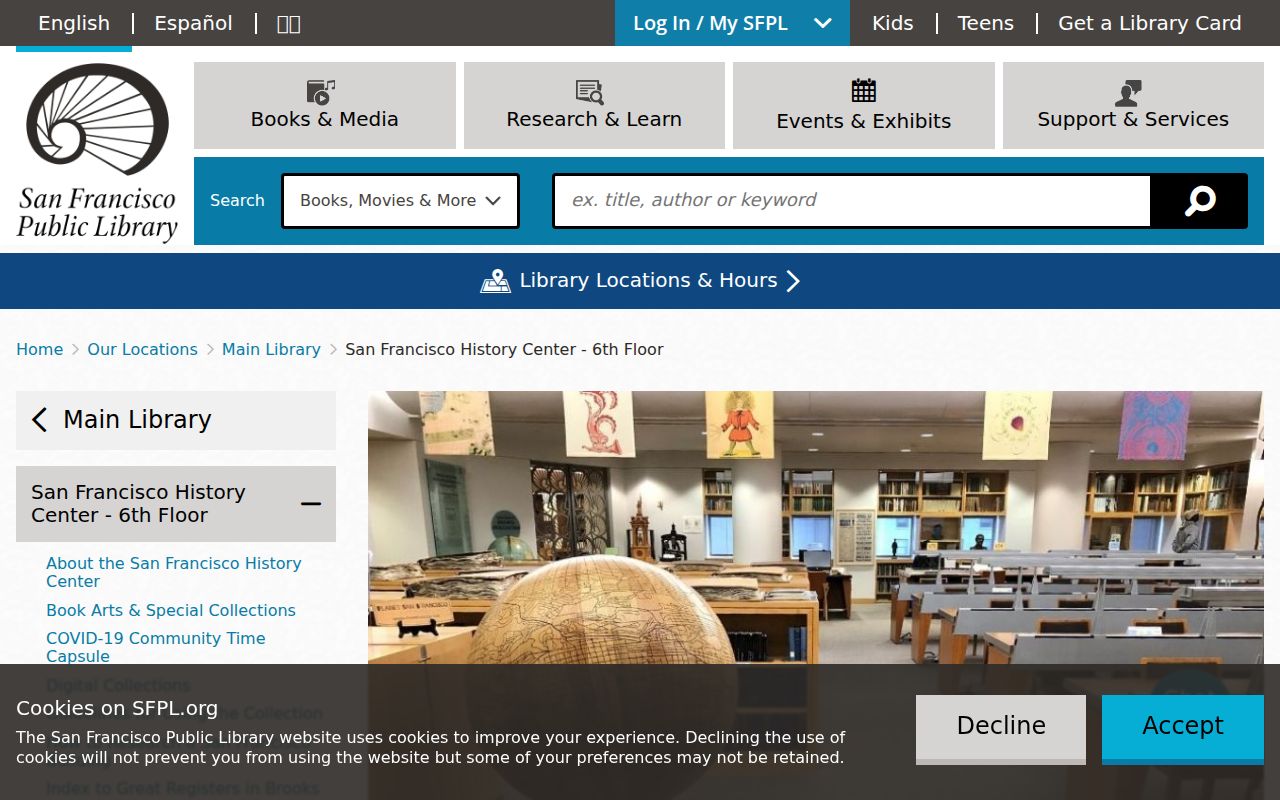
The local-history room is where a catalog gap can turn into a shelf request, card-file lead, or staff-assisted search.
Digitized San Francisco City Directory Years
SFPL's Bay Area city-directory page links year by year where a digitized San Francisco copy exists, often through Internet Archive or related library collections. The Library of Congress telephone-directory collection adds San Francisco telephone books from 1901-1975. The San Francisco State Library's genealogy and California-history collections add San Francisco newspapers, county histories, and reference help, while the National Archives San Francisco page points toward federal holdings such as naturalization, immigration, and court material.
The digitized directory list is the source to check before treating a year as online.
The Library of Congress telephone-directory collection adds digitized San Francisco telephone books for its covered years.
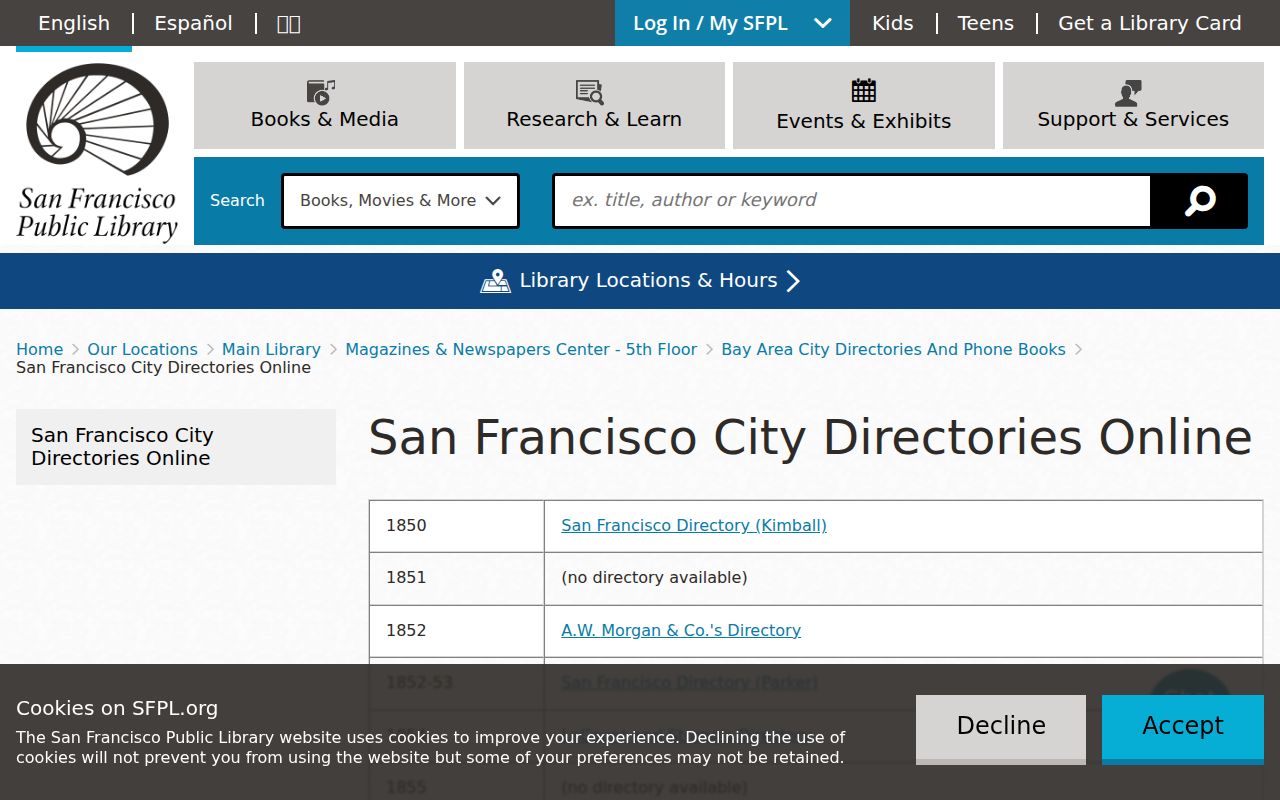
Digitization makes San Francisco page turns easier, but the original volume's abbreviation key and publisher context still control how a San Francisco entry should be read.
Read a San Francisco City Directory Entry
A San Francisco alphabetic entry usually starts with surname and given name or initial. Later San Francisco Polk conventions may put a spouse in parentheses. A widow may appear with a `wid` notation and a deceased spouse's name. Occupation, employer or business relation, home address, and an owner or householder mark can follow. In a San Francisco street section, the order reverses: street name, house number, and a listed person or business.
| Entry detail | What it may mean |
|---|---|
| San Francisco name | Surname, given name, initial, spouse, or widow notation in the volume's style. |
| San Francisco occupation | A trade, profession, employer relation, or business role printed by the publisher. |
| San Francisco address | House number and street; residence and rooms abbreviations depend on the era. |
| San Francisco home or business mark | An `h` or `r` can distinguish residence, rooms, or another use according to the key. |
| San Francisco owner or householder clue | A symbol or label in selected runs that needs the volume's own explanation. |
- Criss-cross section
- The street or telephone half of a later directory, arranged to find a listed name from an address clue.
- Householder index
- A name or address aid that can point to the person treated as the main household contact.
- Abbreviation key
- The volume's legend for marks such as `h`, `r`, `bds`, `clk`, `lab`, and `wid`; photograph or transcribe it first.
- Index versus image
- A search result or list points to a page; the scanned page supplies the surrounding context.
San Francisco women may appear under a husband's identity in early volumes. Boarders, Chinese residents, transient workers, and people outside a publisher's canvass are undercounted. Read the entire page, check the key, and compare the address with a second San Francisco year.
San Francisco Address-First Searching
Regular reverse sections do not begin until 1953, so an address-first search for an earlier San Francisco city directory volume needs the special runs. The 1933 and 1936 San Francisco Street Address Lists, 1940 House and Street Directory, and 1943 and 1949 Andrews Real Property Directories each offer a different route from street to person, business, or owner. Check whether the San Francisco entry uses the same street spelling and number as the target year.
For a 1900-1940 voter clue, Ancestry Library Edition's California voter database can search a quoted address. Great Registers at SFHC cover 1866-1964 with an incomplete 1985 set. The online portion includes 1867-1940, while 1945-1964 needs 48-hour notice. These registers can add age, party, and sometimes occupation to a directory listing.
Use street, cross street, spouse, employer, and neighboring names when a direct address search fails. Address formats changed. A missing entry may reflect a publication gap rather than a missing person.
Trace a San Francisco Household
A San Francisco directory is most useful as a sequence. Pick a known census, marriage, birth, death, or deed year. Search the alphabetic section for exact and variant surnames. Record the San Francisco address, occupation, spouse, employer, and any symbol. Move one available year at a time. Then use a reverse section or special San Francisco address list to test whether other names were listed at the same location.
- Choose a known year and write the person's exact name, initials, address, and related names.
- Search the closest available San Francisco city directory before and after that year.
- Follow address changes and note the first and last appearance instead of jumping over gaps.
- Pair directory years with the 1860-1950 federal census, Great Registers, or California voter registrations.
- Close the trail with an obituary, probate record, cemetery source, deed, or later directory, and label uncertainty.
A disappearance can mean death, a move, omission, publisher coverage, a street change, or a gap in the run. Search the spouse and employer when the head of household fails. Census schedules are public for San Francisco through 1950 under the 72-year rule; HeritageQuest with an SFPL card or PIN, NARA, and FamilySearch are useful access points.
San Francisco's 1906 Directory Break
The April 1906 earthquake and fire are a records problem as much as a local history story. January and October 1906 block books offer before and after ownership snapshots. Pair them with the 1906 directory entries, newspaper notices, deed indexes, water applications, photographs, and surviving permits. A move after the disaster can be traced more honestly when each source is dated.
SFPL recommends Raking the Ashes: Genealogical Strategies for Pre-1906 San Francisco Research. The method also explains why an apparent gap in a directory run should not be filled by guesswork. A household may have moved, changed its name order, lost a building, or appeared in a newspaper when a civil record did not survive.
The History Center's municipal-archive role helps here. Catalog absence is not proof that no record exists. Ask about card indexes, block books, water applications, photographs, and folder material tied to the address.
San Francisco Newspapers and Collections
SFPL's obituary and related-resources guide points to the Daily Alta California, Morning Call, San Francisco Call, Chronicle, Examiner, microfilm, historical databases, and Heritage Hub. Notices can connect an address to kin, occupation, a funeral, or a move. A newspaper statement still needs corroboration, especially when the name is common.
The 1949 Chinese directories correct some of the limits of English-language runs. Searchers should allow bilingual entries, reordered Chinese names, transliteration differences, and community-specific publishers. The Hormel LGBTQIA Center, Chinese Historical Society materials, Jewish genealogical groups, archdiocesan or parish archives, university special collections, yearbooks, and student newspapers can bridge a directory gap under each repository's rules.
SFPL's obituary resource page provides the newspaper and death-index routes.
An obituary or community entry is strongest when its date, address, and relationship align with a directory or official record.
State and Federal San Francisco Shelves
The California State Library genealogy collection offers California history, newspapers, county histories, and research help. Its collection can supply a fallback when a specific directory year is not at SFPL. The National Archives San Francisco research page points toward federal holdings, including naturalization, immigration, and court records that can add identity or arrival context.
NARA's San Francisco holdings page gives the federal archive route.
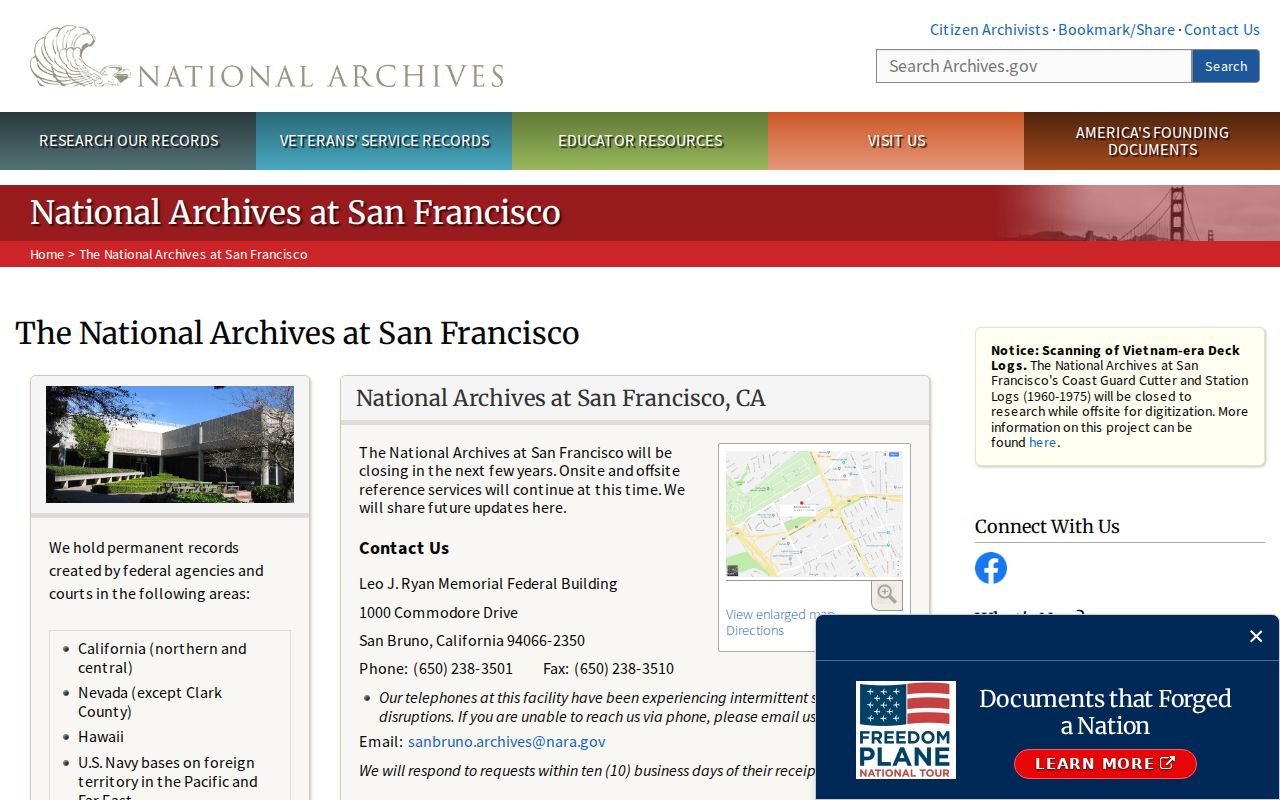
Archives can fill a directory gap, but each record group has its own access rule, indexing depth, and privacy boundary.
The State Library genealogy page supplies a second historical fallback.
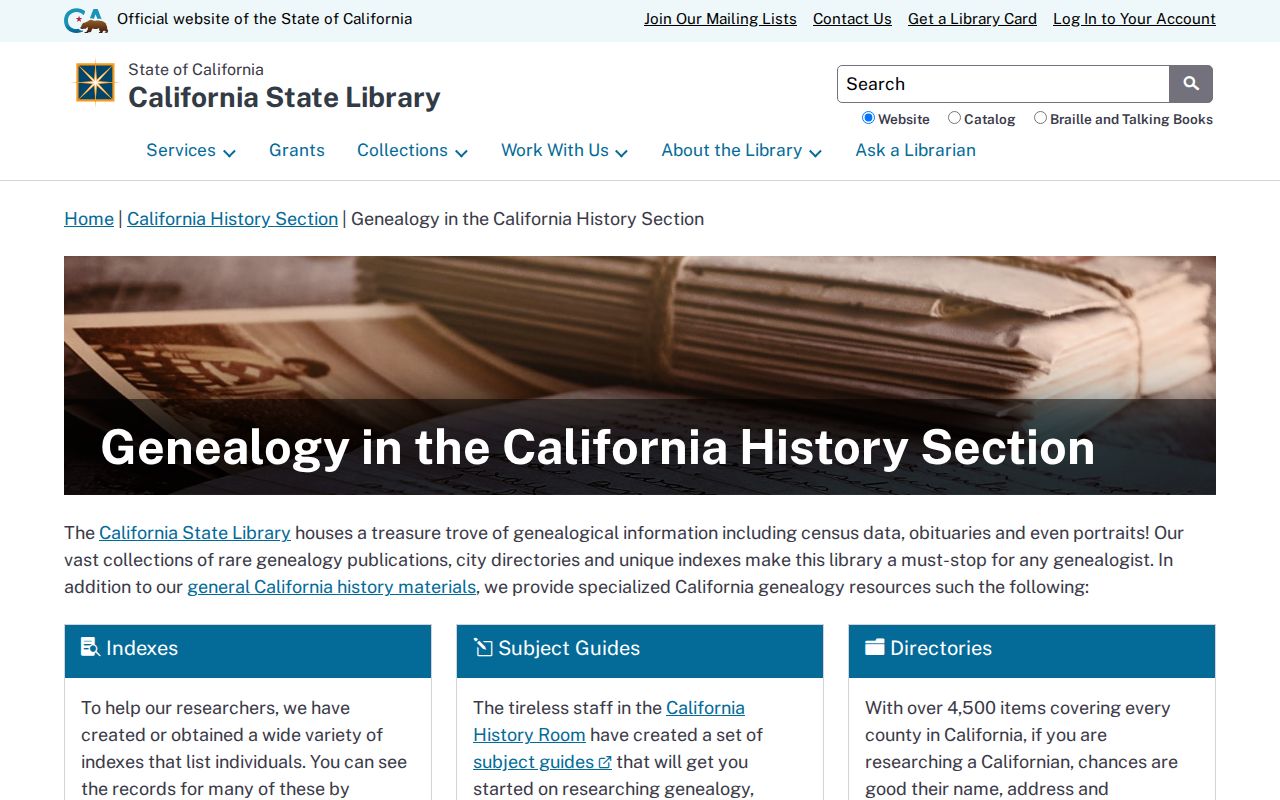
A directory shelf becomes more useful when the archive, newspaper, census, and vital-record paths are treated as companions rather than substitutes.
[RESEARCH GAP: a successful historical-society holdings screenshot was not available in the manifest.] California Historical Society and Online Archive of California finding aids remain additional repository routes.
San Francisco City Directory Limits
Printed San Francisco directories were publisher projects, not universal population registers. Canvass boundaries, subscription habits, name conventions, language, race, gender, occupation, and the choice to omit an entry shaped what appeared. Early San Francisco volumes may list women under a husband's identity. Boarders, children, transient people, and households outside the publisher's reach can disappear from a page.
Do not turn San Francisco absence into proof. A directory can establish that a San Francisco name and address were printed together in a given edition. It cannot by itself prove a current household, a legal relationship, or a continuous residence. Pair it with a San Francisco deed, census, voter register, obituary, or other record whose question matches the conclusion.
Library timing. SFPL requires 48-hour notice for some 1945-1964 voter registers and the 1925 block-book set. Verify offsite access before travel.