
How San Francisco Residents Directory Searches Work
A useful San Francisco residents directory search begins with a San Francisco question, not a name box. A San Francisco address points toward the San Francisco Planning Property Information Map, the San Francisco Assessor-Recorder, San Francisco permits, and historical reverse directories. A San Francisco name may lead to a San Francisco Superior Court party index, a professional license, a business filing, or an obituary. A San Francisco family-history question may need a San Francisco city directory, voter register, census schedule, or vital-record index. None of those San Francisco records is a complete list of people in a home.
Use a short San Francisco chain, and write down the date of every San Francisco result. Start with the source closest to the known San Francisco fact. Then check a second official or archival San Francisco source before treating two records as one person. That habit matters in a dense San Francisco city with common names, multilingual name order, changing San Francisco addresses, and a large share of residents who do not appear in an owner roll.
- Define the San Francisco clue: exact spelling, initials, address, block and lot, business, date, or relationship.
- Use the San Francisco Assessor Property Search or San Francisco PIM when the clue is a parcel or street.
- Use the San Francisco court index, business filing, license search, or vital index when the clue is a person.
- Pair a current San Francisco record with a directory, voter register, census, obituary, or deed when the question reaches backward.
- Ask the San Francisco custodian for an existing record when a portal stops, using the California Public Records Act only for a record that can be identified.
For a street-by-street chain, the San Francisco street directory route keeps the address as the organizing key. For a single person, the San Francisco resident lookup route gives names, party roles, and dates more weight than a loose name match.
Where San Francisco Keeps Resident Records
San Francisco's consolidated government removes a common county-versus-city puzzle, but it does not make San Francisco records interchangeable. The San Francisco Assessor-Recorder handles San Francisco parcel assessment and recorded instruments. The San Francisco County Clerk handles marriages, fictitious business names, notary bonds, domestic partnerships, and professional registrations. San Francisco Superior Court holds cases, probate, family matters, and small claims. The San Francisco Department of Elections authenticates an individual voter rather than publishing a public name list. The San Francisco History Center acts as a municipal archive as well as a library collection.
Assessor-Recorder
San Francisco City Hall Room 190
San Francisco, CA
Contact through the office page
County Clerk
San Francisco City Hall Room 168
San Francisco, CA
Service details vary by record
Department of Elections
San Francisco voter authentication service
San Francisco registered-residence search
No public by-name browse
The San Francisco Assessor-Recorder office information is the right starting point for San Francisco ownership and transfer questions. San Francisco recorded-document copies follow a separate service route, while older San Francisco name indexes require a different handoff to the San Francisco History Center or FamilySearch. The California Public Records Act, Government Code section 7920.000 and following, is a fallback for identifiable, nonexempt San Francisco records, not a command that an office create a new directory.
San Francisco Parcels Are Not Household Rolls
The San Francisco Assessor Property Search is block-and-lot and address oriented. Its San Francisco public-facing design does not advertise an unrestricted owner-name browse. The San Francisco PIM map adds parcel geometry, zoning, districts, planning cases, permits, and historic-resource links. Together they can turn a San Francisco address into a parcel key. They cannot turn a San Francisco parcel into a list of every person who sleeps there.
| Search field or result | What it contributes |
|---|---|
| San Francisco address | Finds a San Francisco situs parcel; normalize the street suffix and preserve the exact number. |
| San Francisco block and lot | Connects a San Francisco parcel to assessment, permits, maps, and recorded-document research. |
| San Francisco map click and layers | Shows San Francisco parcel geometry, adjacent lots, zoning, districts, planning, and historic context. |
| San Francisco assessment result | Shows public value and property characteristics; access presentation controls owner and mailing details. |
| San Francisco permit context | Connects a parcel to DBI applications, work descriptions, inspections, and complaints. |
Keep three San Francisco address concepts apart. The San Francisco situs is the physical parcel. A San Francisco tax-mailing address is where assessment correspondence goes and may point elsewhere. A San Francisco deed's legal description is the title language that carries a parcel backward when street names change. None proves occupancy. Current San Francisco property context belongs in an address-led search, not in a claim that an owner is the resident.
[RESEARCH GAP: the successful assessor property-search screenshot required for the home page was not available in the manifest.] The official Assessor Property Search remains the live route for the fields described above.
Why San Francisco Voter Lookup Stays Private
The San Francisco Elections Voter Portal asks for a San Francisco house number, ZIP Code, and date of birth. It returns the authenticated voter's San Francisco registration status, districts, vote-by-mail status, ballot information, and participation history. Participation shows whether or how a ballot was cast, never the choices made. It is a personal service, not a public San Francisco residents directory searchable by neighbor name.
California's broader San Francisco voter file has a separate access path. Elections Code sections 2188 and 2194, Government Code section 7924.000, and related regulations restrict disclosure to approved electoral, scholarly, journalistic, governmental, or political purposes. A San Francisco application asks for the applicant and organization, requested geography or file, intended use, safeguards, and a sworn agreement. The research file reports $15 per 1,000 records, capped at $100, or $30 for a specific registration record, also capped at $100. Approval is not automatic.
Historical Great Registers are different archival records. San Francisco History Center holdings cover 1866-1964 with an incomplete 1985 set, while online portions cover 1867-1940. They may show a San Francisco name, address, age, party, and sometimes occupation. Access to 1945-1964 San Francisco material needs 48-hour notice. A portal miss is not proof that a person never lived at a San Francisco address, since records can be confidential, pending, inactive, or entered under a different form.
The official voter portal screen makes the authentication distinction visible before a search begins.
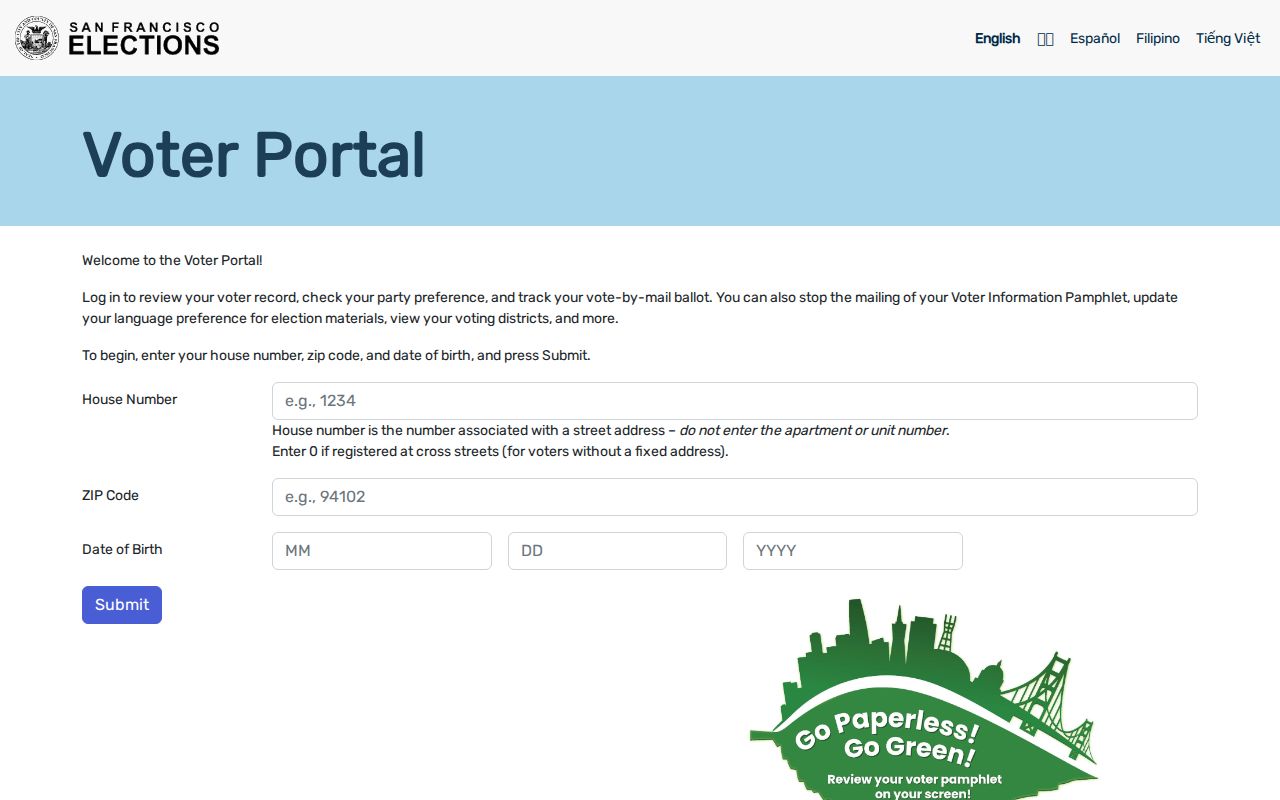
The result is useful to the voter who supplied the credentials, but it is not evidence for an ordinary public by-street roster.
Current San Francisco Residents Directory Sources
Modern San Francisco records can create a useful set of leads when each source is kept in its lane. A San Francisco parcel record can establish an owner or tax-mail destination. A San Francisco court record can establish a party role. A San Francisco business or license filing can establish a dated professional affiliation. A San Francisco city dataset can establish a permit or public appointment. The sources below do not promise that everyone in a San Francisco household appears.
| Source | Who or what it records | Keeper | Access |
|---|---|---|---|
| San Francisco Assessor and PIM | San Francisco parcel, assessment, owner context, mailing destination when lawfully visible | San Francisco Assessor-Recorder and Planning | Free web tools and office routes |
| San Francisco recorded instruments | San Francisco grantors, grantees, liens, easements, releases, legal descriptions | San Francisco Recorder Division | Index and paid copies |
| San Francisco Superior Court index | Named parties in San Francisco civil, family, probate, and small-claims cases | San Francisco Superior Court | Free index; images vary |
| San Francisco business and license files | Officers, agents, licensees, status, and public professional role | California Secretary of State and DCA | Free search with board limits |
| San Francisco city and civic datasets | San Francisco permits, complaints, businesses, boards, and commissions | San Francisco departments | DataSF and department portals |
The residents directory becomes more persuasive when a current San Francisco source has dates and roles that align. A San Francisco property result plus a deed party is still an ownership trail, not a household result. A San Francisco license address is an address of record, not necessarily a home. A San Francisco directory entry is a publisher's historical listing. Searchers who need one identity can shift to a one-person San Francisco resident lookup workflow.
Five San Francisco Resident Identity Checks
Same-name mistakes in San Francisco are easier to avoid when each record adds a different kind of evidence. The San Francisco resident lookup research separates parcel ownership, recorded instruments, voter registration, court parties, vital events, business filings, professional licenses, and historical directories. A residents directory match uses a San Francisco date and role, not just a familiar spelling.
- Parcel: confirms a person or entity appears in an ownership context, with the occupant question left open.
- Deed: confirms that a named party received or transferred an interest on a date.
- Court: confirms a case party, case type, filing date, and later register activity.
- Business or license: confirms a public professional or entity affiliation and its snapshot date.
- Directory or vital index: supplies historical address, household, relationship, or event context.
- Roll
- An organized list kept for a purpose, such as assessment or voter registration, rather than a complete census of residents.
- Index
- A finding aid that points to a record. It may show a name and date without showing the document image.
- Parcel
- A mapped piece of San Francisco land identified locally by block and lot, even when one building contains several lots.
- Criss-cross directory
- A reverse directory arranged by San Francisco address or telephone so a search can move from place to listed name.
For a San Francisco court match, save the case number, caption, filing date, party role, and disposition or current status. For a San Francisco deed match, save the document number or book and page, instrument type, grantor, grantee, and legal description. Those San Francisco details let the custodian correct a wrong result and keep a research note auditable.
What San Francisco Court Records Show
The San Francisco Superior Court online-services menu leads to San Francisco civil, family, probate, and small-claims name searches. The official coverage guide begins those San Francisco case-name searches with filings from 1987. Criminal search is separate. San Francisco civil registers of actions can be viewed, while image availability varies by category and year. San Francisco civil images and estate or trust probate images begin in 2001, and San Francisco small-claims images begin in 2008. Family registers need the case number and family images are not online.
| Result field | How to read it |
|---|---|
| Caption and party role | Shows who appears in the San Francisco case and whether the person is a petitioner, respondent, plaintiff, defendant, fiduciary, or another role. |
| Case number and type | Anchors the record to a San Francisco court file and distinguishes civil, family, probate, or small claims. |
| Filing date | Places the San Francisco event in time and helps separate people with the same name. |
| Register of Actions | Lists San Francisco dates and docket descriptions; a missing image does not mean a missing filing. |
| Disposition or status | Shows the San Francisco procedural outcome when posted; a complaint alone is an allegation. |
San Francisco federal matters use PACER and the Northern District of California's public-access information. PACER is not a criminal-history report, and sealed filings do not appear. Older San Francisco local files, restricted matters, and non-image documents require the appropriate clerk or public terminal. Ask for the San Francisco case number first, then a register and selected filings instead of an entire file.
The court service page shown in the capture is a menu of routes, not a promise that every file has an online image.
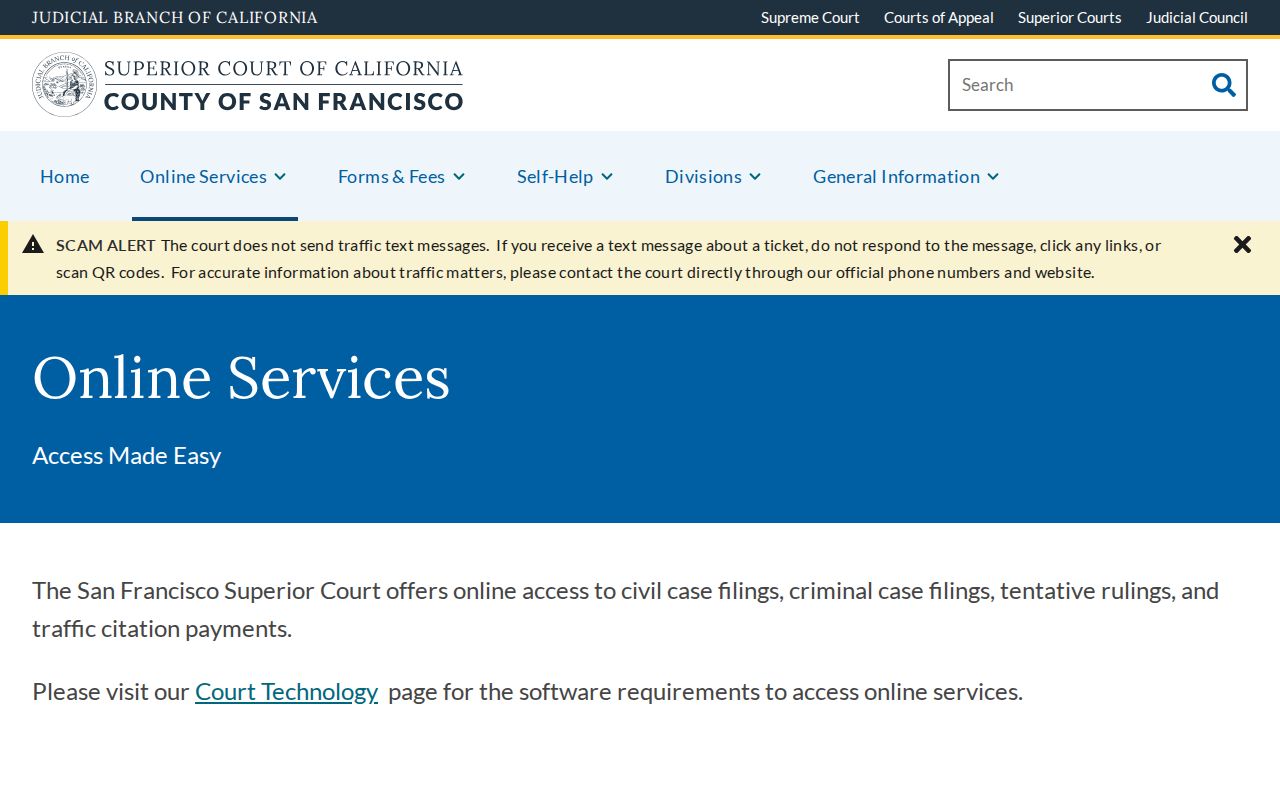
Use a docket to anchor a name to a case role and date, then corroborate the person with a separate official source.
California Records Requests for San Francisco
The San Francisco public-records request route lets a requester select a San Francisco department, describe identifiable existing records, provide contact and delivery details, and track the request. California's CPRA normally gives an agency 10 calendar days to determine whether responsive San Francisco records exist under Government Code section 7922.535. An unusual-circumstances extension may add up to 14 days. That is a determination deadline, not a fixed promise of production.
Ask for a named San Francisco dataset, date range, address, block and lot, case number, document number, or record type. The law does not require a San Francisco office to build a new list or answer a research question. Nonexempt portions can be released while exempt material is redacted. Government Code section 7922.530 permits direct duplication costs, and section 7922.575 addresses electronic extraction or programming in the circumstances described by the statute.
The statewide copy rule is useful when a San Francisco portal ends. A CPRA request cannot override sealed court matters, confidential marriages, adoption restrictions, voter-file purpose rules, DMV protections, or Safe at Home confidentiality. Describe the existing San Francisco record and let the custodian apply the exemption.
California's copying provision is shown in the source capture linked here.
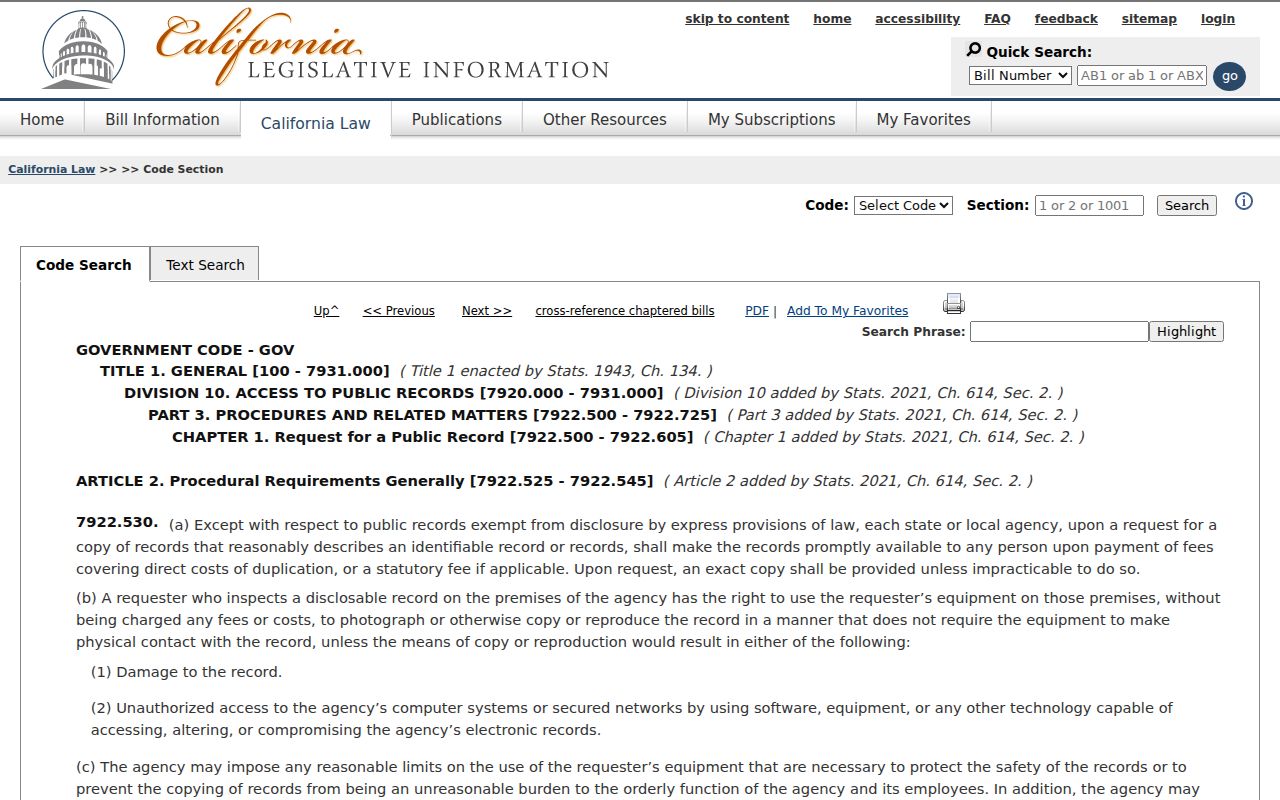
The legal route works best when a request names a record that San Francisco already keeps.
San Francisco's Historical Directory Shelf
The San Francisco History Center is the San Francisco city directory fallback when a current portal cannot establish an older household. SFPL's San Francisco collections include city directories from 1850-1982 with gaps, reverse directories, voter registers, census resources, block books, deeds, maps, photographs, water applications, permits, manuscripts, and city archives. The fifth-floor Magazines and Newspapers Center houses San Francisco directories, telephone books, and newspapers. The Daniel E. Koshland San Francisco History Center is on the sixth floor of the Main Library at 100 Larkin Street and lists 415-557-4567 and sfhistory@sfpl.org in the research material.
SFPL's digitized San Francisco directory list traces publishers from Kimball and A.W. Morgan through Parker, LeCount and Strong, Colville, Langley, Crocker-Langley, and Polk. Regular reverse sections begin in 1953. Haines criss-cross volumes run 1976-2021. The full year and publisher sequence belongs with the San Francisco city directory collections, where the San Francisco entry keys and gaps can be read beside the shelf locations.
San Francisco library collections are not an afterthought. A San Francisco card index or folder list may answer a question that does not appear in the online catalog. SFPL's 2026 notice says bound-volume requests from offsite storage are temporarily unavailable, so call before relying on a trip for a particular San Francisco volume.
The History Center collection description shows why the library functions as a municipal archive.
The DataSF public datasets portal supplies the local civic-data view shown in the capture.
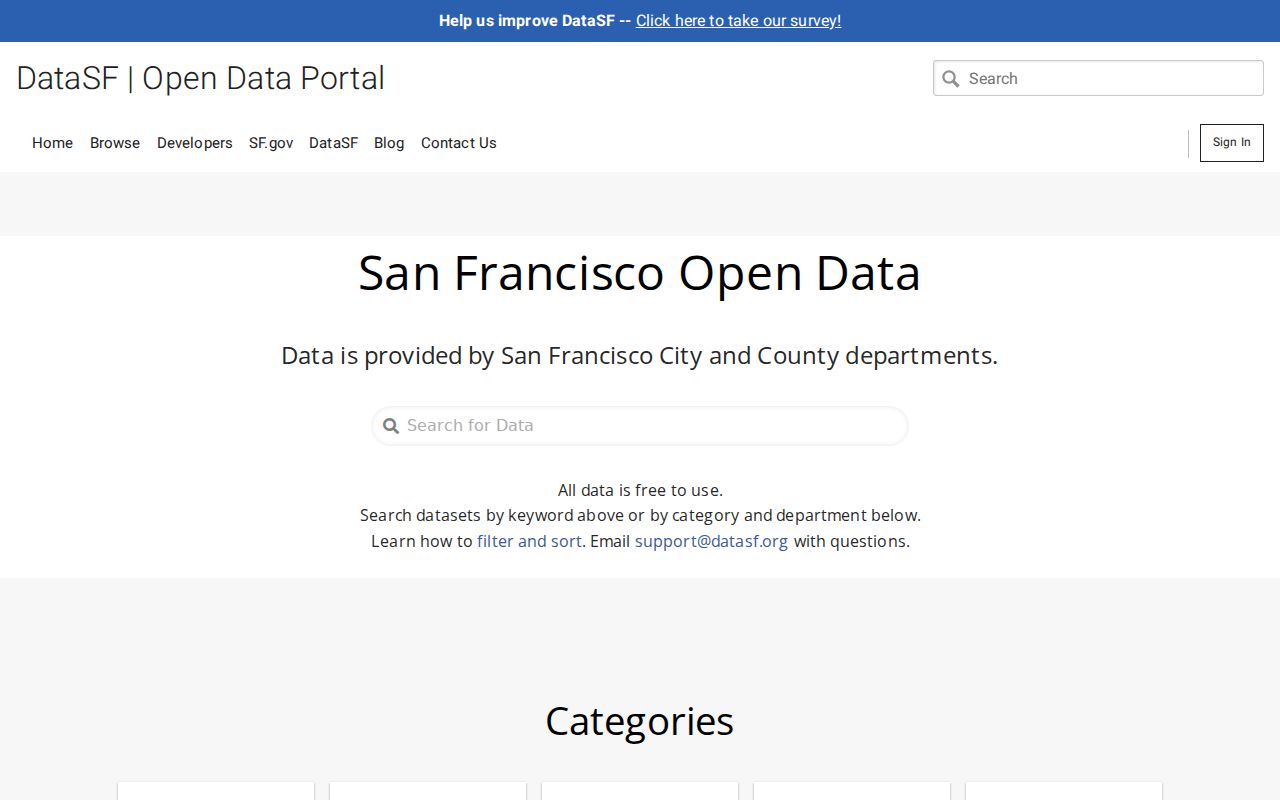
Historical directory research is strongest when a printed listing is paired with a deed, voter register, census, newspaper notice, or obituary.
San Francisco Resident Searches With Purpose
Different San Francisco personal questions call for different record trails. A San Francisco heir search can begin with a probate petition and an obituary. A former San Francisco classmate may appear in SFPL yearbooks, school archives, newspapers, or a public alumni office. A San Francisco business-owner question may pair California Secretary of State bizfile with a San Francisco County Clerk fictitious business name filing. A San Francisco birth-parent search must use California's CDSS adoption-information, mutual-consent, or court procedures, because adoption files are not an open directory.
Unclaimed property can add a San Francisco historical clue. The State Controller's search accepts an owner or business name, first name, middle initial, city, and property ID. A result can show a reported San Francisco address, holder, property type, and property ID. It points to a past financial relationship, not a current San Francisco residence. The same caution applies to San Francisco professional license addresses and business filings.
For custody questions, the San Francisco Sheriff locator is a current San Francisco local jail route. California's CDCR CIRIS, the federal Bureau of Prisons locator, and California's Megan's Law site have their own warnings and limits. A San Francisco custody or registry result must be read as the narrow record it is, never as proof of a broader identity or outcome.
The Sheriff's custody locator is one of the local sources captured for the San Francisco residents directory.
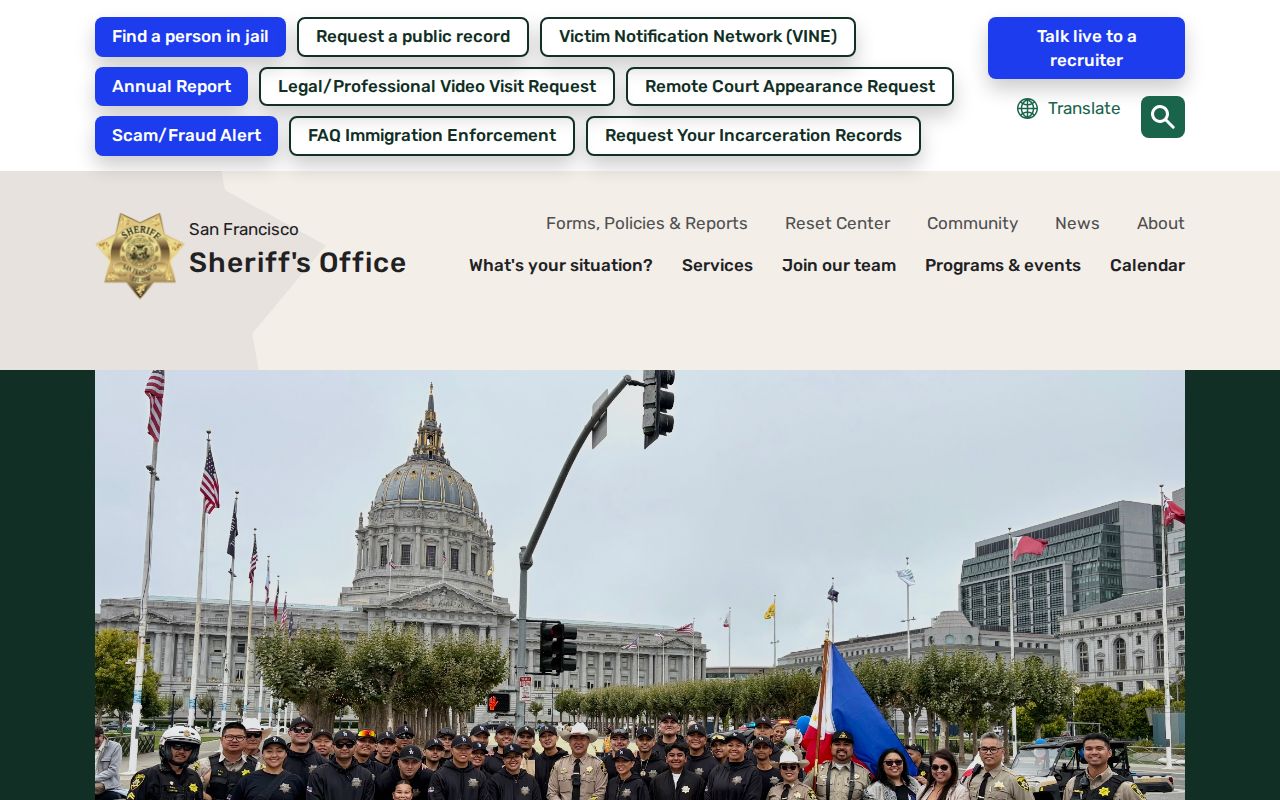
Official custody information has a narrow purpose and should be checked against the agency that maintains it.
San Francisco Protected Addresses Need Care
California Safe at Home gives qualifying San Francisco survivors a substitute mailing address and confidential mail forwarding. Confidential San Francisco voter registration can also shield a participant. The program covers qualifying survivors of domestic violence, stalking, sexual assault, trafficking, child abduction, elder or dependent-adult abuse, and qualifying reproductive-health participants. Protection is not a universal deletion of every public San Francisco source. Buying real property in one's own name can still place a legal description in San Francisco assessor records.
California's CCPA and CPRA give covered-business consumers rights to know, delete, correct, limit sensitive information use, and opt out of sale or sharing, subject to exceptions. Those rights concern covered San Francisco businesses and data brokers. They do not erase a San Francisco Recorder deed, court file, or government roll. DMV motor-vehicle information is separately protected, and San Francisco voter data has statutory purpose limits.
Lawful personal use. Public records support genealogy, reconnecting, civic research, and personal safety awareness. Do not use a San Francisco residents directory result to stalk, harass, threaten, impersonate, or harm anyone.
When a result is wrong, contact the custodian rather than a republisher. The Assessor handles assessment data, the Recorder handles indexing and redaction, Superior Court handles docket and file questions, the Secretary of State handles entity statements, licensing boards handle license records, and Elections handles voter registration.
San Francisco Records Versus Compiled Results
Commercial people-finder services may combine San Francisco public filings, marketing data, and other datasets. They can merge people with the same name, lag San Francisco corrections, or display an old address. They may be useful only as a lead for lawful personal research, and an opt-out from a compiled service does not remove the San Francisco government source.
| Question | Official or archival source | Compiled result |
|---|---|---|
| Who owns a parcel? | San Francisco Assessor, PIM, and Recorder documents with block, lot, and legal description | May repeat a stale San Francisco owner label without the title image |
| Was someone a court party? | San Francisco Superior Court case number, caption, role, register, and available filings | May merge San Francisco case names or omit disposition context |
| Who lived at an old address? | SFPL directories, reverse volumes, census, voter registers, and newspapers | May present an unsupported current San Francisco address guess |
| How is a business connected? | San Francisco bizfile, FBN, license, and dated public filings | May flatten a role or old San Francisco mailing address |
Certified proof comes from the custodian, not from a search summary. A residents directory summary is only a lead. An index may be free while a certified copy or image carries a fee. Keep the San Francisco source date, URL, and record identifier with every conclusion.
The FTC fraud-reporting portal is a safer response when a supposed records result becomes a payment demand or identity scam.
Do not confront a person using an address found in a record. Preserve the notice, caller details, receipts, and screenshots, then use an official reporting channel.
San Francisco public-safety questions belong with the local public-safety resource directory or the named agency, not with a private search result.
San Francisco Records Across the 1906 Break
The April 1906 San Francisco earthquake and fire destroyed enormous civic and private record context and displaced San Francisco residents. A single missing San Francisco civil record does not end a search. January and October 1906 San Francisco block books offer paired ownership snapshots. San Francisco directory runs, newspaper notices, deed indexes, water applications, photographs, and permits can be read together to reconstruct a San Francisco house or household.
The San Francisco land trail has its own repository break. San Francisco Assessor-Recorder staff direct ownership and transfer research from 1914 forward. SFPL holds an incomplete 1848-1913 San Francisco grantor and grantee index, with selected deed volumes from 1848-1863 and 1894-1906. Searchers who cross that San Francisco line should preserve the block and lot, deed book and page, party role, and legal description rather than relying on a modern street spelling.
SFPL's guide, Raking the Ashes: Genealogical Strategies for Pre-1906 San Francisco Research, captures the San Francisco local method. The strongest San Francisco residents directory work is often a braid of modest sources rather than one perfect result.
Recent San Francisco Record Changes
Current San Francisco fees and access rules need a date beside them. CDPH vital-record certified-copy fees changed January 1, 2026 under AB 64, so the live state fee page controls over older San Francisco summaries. San Francisco County Clerk FY2025-26 certification lists a public or confidential marriage license at $91, a duplicate marriage license at $30, an FBN filing at $67, and an additional name or registrant at $17.
SFPL's January 17, 2026 San Francisco notice says equipment problems at offsite storage temporarily prevented fulfillment of bound-magazine requests and recommends checking before travel. California is also implementing the Delete Act's centralized data-broker deletion system through the CPPA. Use current San Francisco agency guidance for the phase and timing rather than assuming that a past opt-out rule still controls.
The San Francisco Real Estate Division's 2025 San Francisco city-owned real-property map is a separate ownership layer when a parcel belongs to the City. A current San Francisco map or fee notice is useful only when its publication date and custodian remain clear.